Why Is My Lash Glue Not Sticking? Common Causes & Solutions
Updated: Sep 27
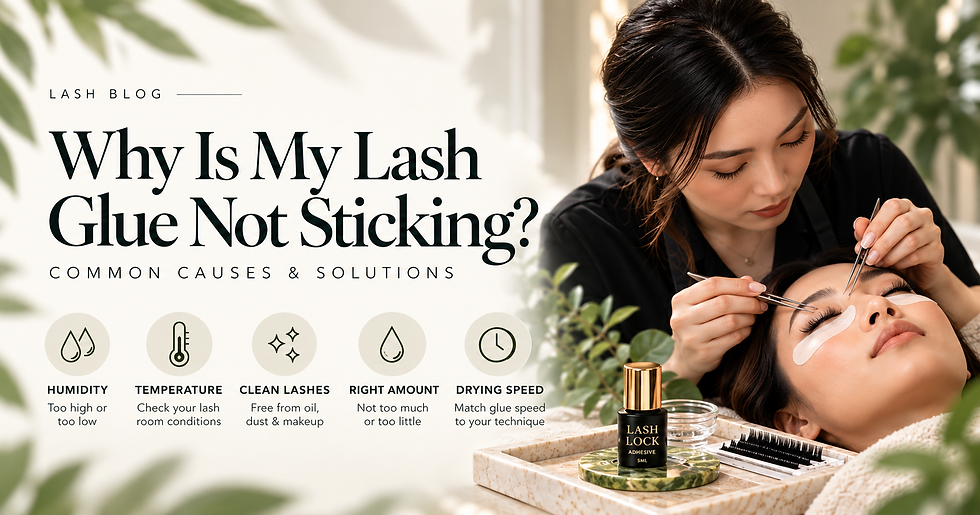
When lash glue is not sticking properly, it can be frustrating — especially when you're using the same adhesive and application technique that normally works well. The natural reaction may be to assume there is something wrong with the glue, but poor attachment can be caused by several different factors.
Natural lash preparation, adhesive drying speed, temperature and humidity, the amount of glue used, attachment technique and adhesive freshness can all affect how well an eyelash extension bonds. Understanding each factor can help lash artists troubleshoot the problem instead of immediately changing products.
Why Is My Lash Glue Not Sticking?
If your lash glue is not sticking, start by looking at what has changed. Is the adhesive curing before the extension reaches the natural lash? Are the natural lashes completely clean? Has the temperature or humidity changed? How long has the adhesive bottle been open?
Identifying when the problem occurs is also useful. If extensions are difficult to attach during application, drying speed or technique may be involved. If application feels normal but retention is unexpectedly poor afterwards, preparation, attachment, adhesive condition or client aftercare may also need to be considered.
The Natural Lashes May Not Be Clean Enough
A clean natural lash provides a better surface for adhesive attachment. Makeup, skincare products, oils and other residue around the lashes may interfere with the bonding process.
Before beginning a set, make sure the natural lashes are properly cleansed and completely ready for application. Lash shampoo can help remove everyday buildup, while a lash primer may be incorporated into your professional preparation routine when appropriate.
Good retention starts before the adhesive is applied, so preparation should be one of the first things you check when troubleshooting attachment problems.
Your Lash Glue May Be Drying Too Fast
A common reason for poor attachment is using an adhesive that cures faster than your working speed.
If the adhesive begins curing before you position the extension correctly against the natural lash, you may not achieve the intended bond. This can sometimes feel as though the extension simply will not stick properly.
The fastest adhesive is therefore not automatically the best adhesive. Your glue should give you enough working time to dip, position and achieve proper attachment before it cures.
LashLock 04 Control has a drying time of approximately 3–5 seconds, while 03 Sensitive provides approximately 2–3 seconds. 02 Fast is designed around a 1-second working time, while 01 Ultra Fast offers an ultra-fast 0.5–1 second drying time for experienced artists working at speed.
Temperature and Humidity May Have Changed
Your lash room environment can affect the behaviour of conventional eyelash extension adhesive. Changes in humidity can influence curing speed, which means an adhesive may behave differently even when you're using the same bottle.
This can be particularly noticeable for lash artists working in Singapore. Outdoor conditions may be humid, while air conditioning can create very different conditions inside the salon.
Using a hygrometer near your lash bed can help you monitor your actual working environment. If your adhesive suddenly behaves differently, checking temperature and humidity can help you determine whether environmental conditions have changed.
Check How Much Lash Glue You're Using
The amount of adhesive used during application can also affect attachment. Too little adhesive may not provide sufficient contact, while using excessive adhesive does not necessarily create a better bond.
The appropriate amount can vary depending on your technique, extension type and adhesive. What matters is creating clean, controlled attachment between the extension and natural lash.
If your glue seems fine but attachment remains inconsistent, observe your dipping and placement technique rather than automatically switching adhesives.
Check Your Attachment Technique
Even a professional lash adhesive cannot compensate for inconsistent attachment.
The extension needs sufficient contact with the natural lash. If only a small part of the extension is attached, or if placement is inconsistent, retention may be affected regardless of which adhesive you use.
When troubleshooting, look closely at your application process. If the adhesive appears to be behaving normally but extensions are still not bonding consistently, attachment technique may be worth reviewing.
Your Lash Glue May No Longer Be Fresh
Professional lash adhesive does not remain in the same condition indefinitely after opening. Repeated exposure to the surrounding environment can gradually affect the product, making it important to keep track of when each bottle was opened.
For LashLock 04 Control, 03 Sensitive, 02 Fast, 01 Ultra Fast, the shelf life is up to 6 months unopened, subject to proper storage and the expiry information stated on the product. Once opened, these adhesives should be used within 3 months.
LashLock LED adhesive has a shelf life of up to 3 months unopened and 1 month after opening, subject to proper storage and the expiry information stated on the product.
Writing the opening date on your bottle can make it easier to track when it should be replaced.
Make Sure Your Lash Glue Is Stored Properly
Storage can also affect the condition of your adhesive. Always follow the storage instructions provided for the specific product and keep the bottle properly closed when it is not being used.
The nozzle should also be kept clean so the cap can close securely. Avoid leaving the bottle unnecessarily exposed during appointments, particularly in environments where temperature and humidity fluctuate.
If an adhesive has been stored incorrectly, replacing it may be more useful than repeatedly adjusting your application technique around a bottle that is no longer performing as expected.
Don't Forget About Client Aftercare
If extensions attach normally during the appointment but retention becomes poor afterwards, the problem may not necessarily have occurred during application.
Client aftercare, natural lash growth and everyday habits can all influence how a set wears over time. Clients should keep their lashes clean using appropriate aftercare and avoid unnecessary rubbing, pulling or picking at their extensions.
Looking at when lash loss occurs can therefore provide useful clues when troubleshooting retention.
What to Check When Lash Glue Is Not Sticking
When your lash glue is not sticking, avoid changing several things at once. Start with the basics: check the natural lash preparation, your room conditions, adhesive drying speed, bottle freshness, storage and attachment technique.
Changing one factor at a time makes it easier to identify what is actually causing the problem. If you immediately change your adhesive, primer, technique and room conditions together, you may solve the issue without ever knowing what caused it.
Consistent lash application comes from understanding how your adhesive works with your technique and environment. When something suddenly feels different, troubleshooting the entire process will usually tell you much more than simply assuming the lash glue is the problem.


Comments